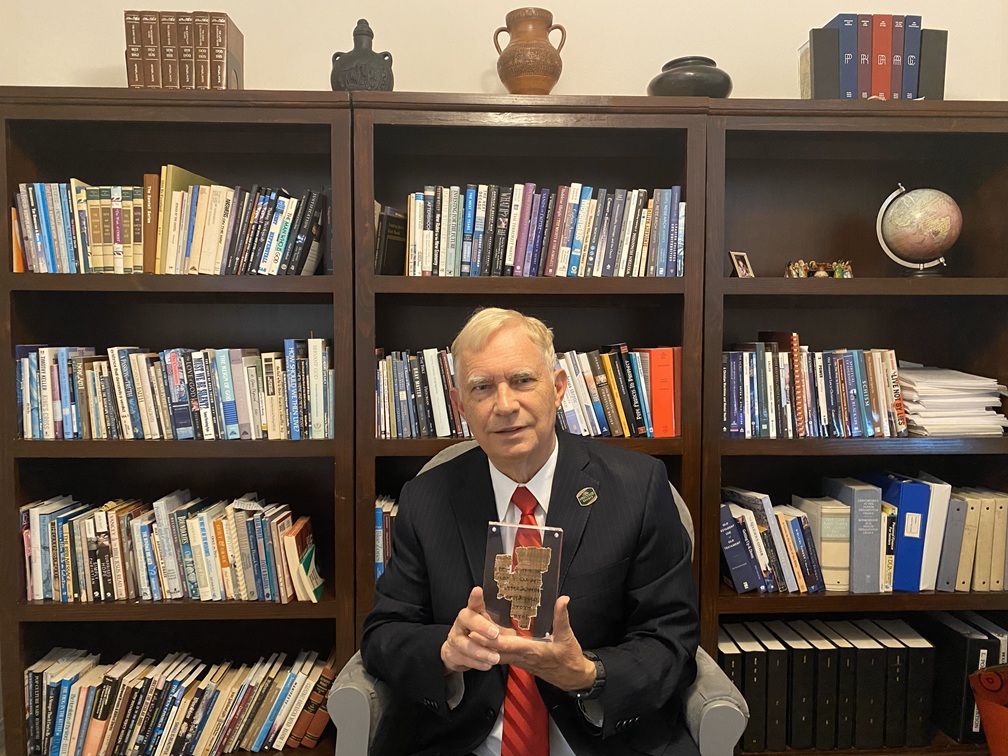
Hello! I am Jon Paulien and I’m glad you came to this page to check out my work. I am a New Testament scholar and Professor of Religion at Loma Linda University. On this website you will find a collection of my articles, commentary on Revelation, and links to my blog, videos, and other resources. Make sure you check the articles link above regularly to see the latest postings. In my hand above is an exact replica of p52, the earliest extant New Testament manuscript fragment, containing portions of John, chapter 18. Centered above my head is a replica of ancient Greek pottery. At either end above are two sets of books from, and about, my favorite spiritual author, Ellen G. White. I hope you enjoy the site.
Daily Devotional For October 26, 2026
View in the Daily Devotional Index
Just as she has glorified herself and lived luxuriously, so give to her torment and pain. Because in her heart she says, “I sit as a queen, I am not a widow, and I will never know pain.” For this reason, in one day her plagues will come; death and mourning and famine, and she will be burned with fire, for strong is the Lord God who has judged her. Rev 18:7-8.
It is clear from the above text that Babylon is not only wealthy, she is fully self-absorbed in this wealth. Her full attention is on her own pleasure and she will defend that position at all costs. She has ignored the teaching of Jesus (Luke 6:38, NIV): “Give, and it shall be given unto you.” This suggests that if you want to be wealthy you have to give your riches away. If you seek to hoard them you will lose them.
This ironic principle is illustrated by the fate of the Vanderbilt fortune. The Vanderbilts differed with their wealthy peers in two respects. First, they had more money. William H. Vanderbilt, president of the New York Central Railroad, left his heirs $200,000,000 upon his death in 1885. That sum had made him the wealthiest man on earth. Second, the family seemed beset with a great reluctance to share any of it’s wealth with those less fortunate than they. Shortly before his death The Commodore, as William H. was known, responded to a Chicago Tribune reporter’s question about social conscience with the expletive, “The public be ******.”
William Vanderbilt was not a total skinflint. He did give a million dollars for the founding of Vanderbilt University and once allowed his wife to persuade him to donate $50,000 for the building of a church, as long as it was specified that the gift was a secular gesture, not a religious one.
The example of The Commodore seems to have been passed on to his descendants. What gifts they made to charity tended to be one-shot gifts, often after death. As was the case with The Commodore’s church donation, there was no personal involvement in the few projects that they supported. Compared to the monumental contributions of the Morgans, the Fords, and the Rockefellers, the bequests of the Vanderbilt family were relatively small. Yet in spite of this careful hoarding of wealth, The Commodore’s fortune is essentially gone today.
It seems that giving provides the sense of purpose that families need to keep the spirit and vigor of the founder alive for later generations. Where wealthy families have no such sense of purpose, they tend to dissipate their wealth in the pursuit of social status and self-gratification. This leads to the dissipation of the family fortune.1 To paraphrase Jesus again, “It is more blessed to give than to receive” (Acts 20:35, NIV).
Lord, touch my heart and the hearts of my children with the joy of giving.
1 Brett Anderson, “Give, and We Shall Receive,” Worth, February, 2004, 64-70.